



WHY FLIP CHIP MICROLED?
Self-Emissive. Pure Performance.
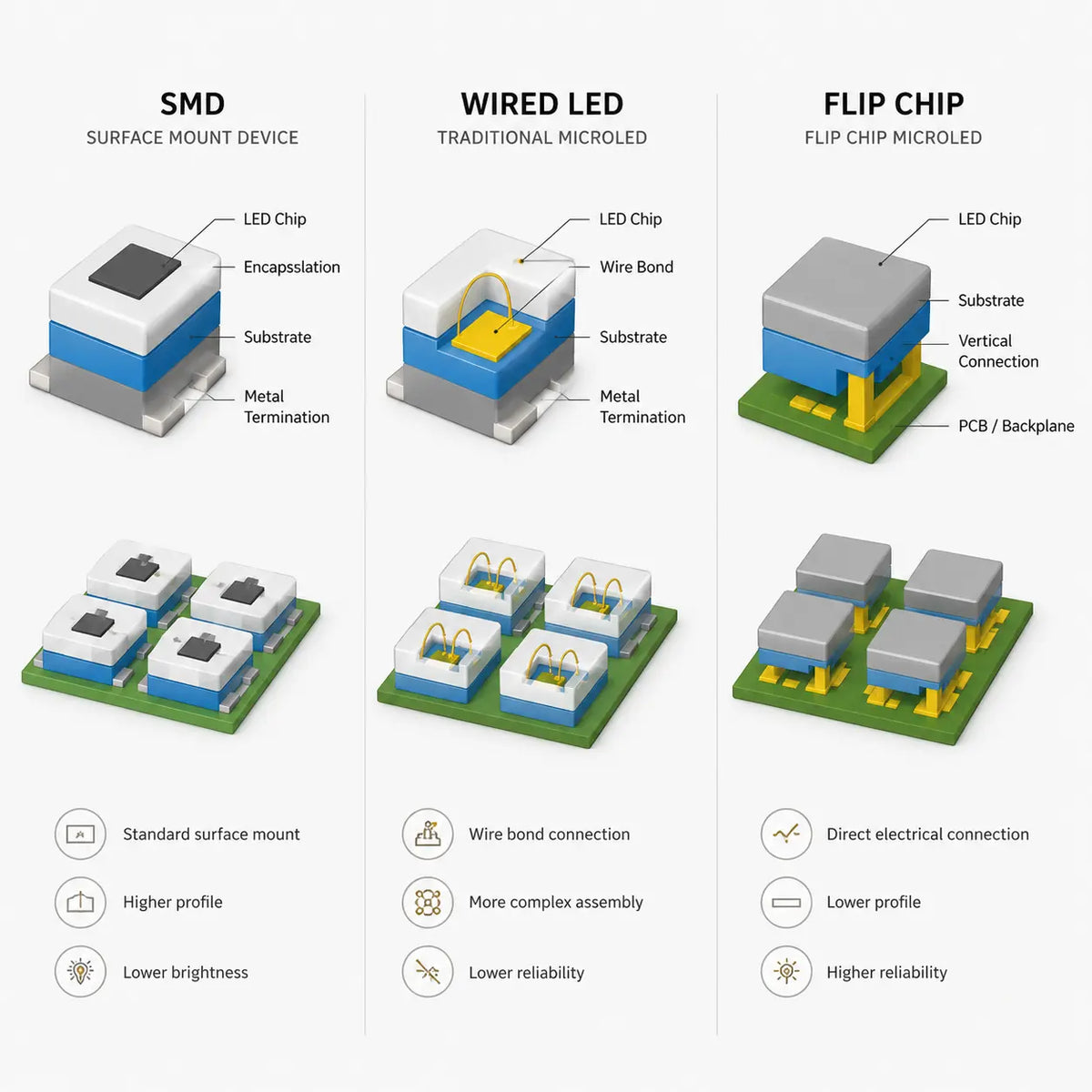
MicroWall uses Flip Chip CoB MicroLED, connecting each LED chip directly to the substrate without the fine gold or copper bonding wires found in traditional wired LED displays.
This creates a more compact and robust structure while removing wire obstructions from the light-emitting surface. The result is improved colour purity, high pixel density and a more uniform display – particularly important for fine-pitch MicroLED viewed at close distances
- Direct Electrical Connection
No traditional wire bonds between the LED chip and substrate. - Purer Colour
Eliminates the visible gold or copper wire structures that can contribute to a warm colour cast. - Higher Pixel Density
Compact construction supports finer pixel pitches and closer viewing distances. - Improved Light Output
Fewer physical obstructions around the LED help maximise the usable light-emitting area. - Greater Reliability
Removing delicate bonding wires eliminates a potential point of mechanical failure.

TRUE BLACKS PERFORMANCE

HDR10+

DCI-P3 COLOUR

3840Hz REFRESH RATE

15,000:1 CONTRAST RATIO
MODULAR CONSTRUCTION
Engineered for Seamless Performance

Every MicroWall is constructed from precision-engineered components that combine to create one continuous display.
At the smallest level are the individual LED chips. These form the CoB modules, which are mounted to lightweight, precision-engineered die-cast aluminium cabinets. Multiple cabinets are precisely aligned to create the finished MicroLED screen.
This modular construction allows MicroWall to be configured in different dimensions and aspect ratios while remaining accessible and serviceable throughout its working life.
- Magnetic Front-Service ModulesDisplay modules attach magnetically and can be removed directly from the front, providing straightforward access to internal components.
- Precision Die-Cast CabinetsLightweight aluminium cabinets provide the rigid, accurately engineered structure required to maintain consistent alignment across the complete display.
- Minimal Installed DepthFront servicing removes the need for a large rear maintenance space, helping keep the total installed depth to approximately 100 mm including the surrounding frame.
- Modular & ServiceableIndividual modules and components can be accessed without dismantling the complete display, simplifying maintenance throughout the screen’s working life.
See Every Detail with HDR10+
HDR10 reveals brighter highlights, deeper blacks and over 1 billion colours, bringing films, sport and games to life with exceptional realism and detail.


Detail You Can See. Pixels You Can't.
MicroWall is engineered to deliver exceptional clarity at every size, with the ideal viewing distance helping you experience the full benefits of MicroLED technology. Our 0.9mm pixel pitch displays are optimised for closer viewing in dedicated cinemas and premium spaces, while 1.2mm displays are ideal for larger rooms and open-plan environments. Our team can help specify the perfect combination of screen size and pixel pitch for your space.


VIDEO PROCESSING
The Intelligence Behind the Image
MicroWall uses professional NovaStar video processing to manage scaling, colour, HDR, source switching and the mapping of content across the display. The processor sits outside the screen itself, allowing multiple sources to be handled, optimised and displayed across the MicroWall canvas.
- HDR10+Supports high dynamic range content with greater detail in highlights and shadows.
- High-Resolution ProcessingHandles large-format content and high-resolution screen configurations.
- MultiViewAllows multiple compatible sources to be displayed simultaneously across one screen.
- Multiple InputsConnects sources such as Sky, Apple TV, Kaleidescape, games consoles and PCs.

MICROWALL + AUDIO
Audio Designed for MicroLED
MicroLED requires a different approach to front soundstage design, with audio systems specifically engineered to work alongside a solid display rather than behind an acoustically transparent projection screen.
Specialist cinema audio manufacturers such as Krix offer dedicated solutions for MicroLED installations, allowing the left, centre and right channels to be positioned around the display while maintaining precise dialogue localisation, stereo imaging and an immersive cinematic soundstage.
Cinema Deco can work with your cinema designer, AV integrator or specialist audio partner to recommend an audio system specifically matched to the size of your MicroWall and the acoustics of the room.
MicroWall vs Projection & Large OLED Displays
| MicroWall CoB | Projection | Large OLED Display | |
|---|---|---|---|
| Daytime Performance | ✓ | — | ✓ |
| Ultra-Large Screen Sizes | ✓ | ✓ | Limited |
| No Lamps to Replace | ✓ | — | ✓ |
| Deep Blacks | ✓ | Moderate | ✓ |
| Architectural Integration | ✓ | Moderate | Limited |
| Long Operational Life | ✓ | Moderate | ✓ |
| Immediate Start-Up | ✓ | — | ✓ |
MicroWall CoB Specifications
| Specification | MicroWall 0.9 | MicroWall 1.2 |
|---|---|---|
| Physical Specifications | ||
| Pixel Pitch | 0.9375mm | 1.25mm |
| LED Type | Full Flip Chip CoB | |
| Cabinet Dimensions |
600 × 337.5 × 38mm 23.62 × 13.29 × 1.50in |
|
| Cabinet Resolution | 640 × 360 | 480 × 270 |
| Panel Weight | 4kg / 8.8lbs | |
| Panel Material | Die-Cast Aluminium | |
| Module Dimensions |
150 × 168.75mm 5.9 × 6.64in |
300 × 168.75mm 11.8 × 6.64in |
| Surface Finish | Matt Finish | |
| Surface Hardness | 4H | |
| Optical Specifications | ||
| Brightness | 600 nits calibrated / up to 1,200 nits peak | |
| Grey Scale | ≥13-bit | ≥13-bit |
| Refresh Rate | 3840Hz | |
| Contrast Ratio | 15,000:1 | |
| Colour Temperature | 3000–10,000K, adjustable | |
| Viewing Angle | H160° / V160° | |
| Scan Rate | 54S | 60S |
| Frame Rate | 60Hz | |
| Driver IC | ICND1069 | ICND1065S |
| Circuit Scheme | Common Cathode | Common Anode |
| AC Operating Voltage | AC 100–240V | |
| Power Draw per Panel Maximum / Average |
85W / 29W | 76W / 26W |
| Minimum Recommended Viewing Distance | 0.9m / 3ft | 1.25m / 4.1ft |
| Default Receiving Card | BR840 Pro | BR460pro-H |
| Colour Space Capabilities | NTSC ≥105% / DCI-P3 ≥95% | |
| Application & Environment | ||
| Storage Temperature / Humidity | −40°C to +60°C / 10–90% RH | |
| Operating Temperature / Humidity | −10°C to +40°C / 10–90% RH | |
| IP Rating — Front / Rear | IP65 / IP43 | |
| LED Half-Brightness Life | 100,000 hours | |
| Module Maintenance | Front Service | |
| PSU & Other Component Maintenance | Front Service | |
| Panel Installation | Wall Mount / Custom | |
| Certifications | CCC, FCC, KCC, CE and CB | |
Power draw may vary by ±10% depending on the content displayed. Specifications are provided for reference and may vary according to the final screen configuration.
MicroLED Technology FAQs
What is MicroLED technology?
What is CoB MicroLED?
What is the difference between CoB and SMD LED?
What does pixel pitch mean?
Should I choose 0.9 mm or 1.2 mm MicroLED?
Can you see the joins between MicroLED cabinets?
Can MicroWall be serviced from the front?
What happens if a MicroLED module fails?
Does MicroWall support HDR10+?
What video processor does MicroWall use?
Can MicroWall show more than one source?
How close can I sit to a MicroWall?
Can MicroWall be made to custom dimensions?
Where are the speakers positioned with MicroLED?
How long does a MicroLED display last?
Speak to Cinema Deco
Ready to Specify Your MicroWall?
Explore standard MicroWall screen sizes, compare 0.9 mm and 1.2 mm pixel pitches and view pricing, or speak to Cinema Deco about a bespoke MicroLED display designed around your space.

OLED vs Projector vs MicroLED: The Complete Comparison
Compare OLED, projector and MicroLED for home cinema and media room use, including picture quality, brightness, screen size, installation, gaming...

Best TV for a Home Cinema in 2026?
Choosing the best TV for a home cinema depends on more than screen size. Compare OLED, MiniLED and MicroLED, including...

Media Room vs Home Cinema: What's the Difference?
Not sure whether to create a media room or dedicated home cinema? Compare the differences in seating, screens, lighting, acoustics...

How to Create a Media Room That Works in Daylight
A bright media room can still deliver a cinematic experience. Discover how to manage glare, choose the right display and...

How much does a home cinema cost in 2026?
Planning a home cinema in 2026? This guide breaks down typical UK costs for media rooms, dedicated cinemas and luxury...

The Ultimate Guide to MicroLED Displays for Luxury Homes
Everything homeowners, architects and interior designers need to know about choosing a MicroLED display for a luxury home cinema or...

The Ultimate Luxury Home Cinema Checklist for New Builds
Planning a new build is the ideal time to create a truly exceptional home cinema. This comprehensive checklist covers room...

Designing the Ultimate Media Room: Seating, Screens and Sightlines
A successful media room is about more than choosing a large screen and comfortable seats. The best rooms are designed...

How Large Should a Home Cinema Screen Be?
The right screen size depends on more than wall space. Viewing distance, resolution, seating layout and room use all shape...

Why More Homeowners Are Choosing MicroLED Over Large OLED TVs
Large OLED TVs offer excellent picture quality, but MicroLED is changing what is possible at home: bigger screens, brighter images,...

MicroLED Displays for Luxury Homes and Commercial Spaces
Learn why MicroLED displays are becoming the preferred choice for luxury home cinemas, media rooms, boardrooms and commercial environments, with...

The CoB LED Revolution: Why CoB MicroLED Is Replacing Traditional SMD Displays
CoB MicroLED is changing large-format display design. Discover how Chip-on-Board technology improves close-range image quality, durability, contrast and architectural integration...